


EcoBlog
The latest thinking on ecological landscapes. Useful tips to improve our environment


Attracting Butterflies: Growing Nectar Plants Isn’t Enough!
There are many, many reasons to use native plants in your landscape. One great reason is to support the caterpillars of butterflies. If you don’t feed those caterpillars, you won’t support the transformation of caterpillars into adult butterflies in your landscape.
Adult butterflies eat mostly nectar found in flowering plants, and most adult butterflies use a variety of plant species to nectar from (“nectar plants”). But the caterpillars of butterflies are another matter altogether. Caterpillars eat the plants themselves, mainly the leaves. Many caterpillars have co-evolved with specific native plants and now depend upon those plants, which are called “host plants.” It’s a critical ecological association. Without host plants, host-specific caterpillars will never make that magical transformation into adult butterflies. It’s worth noting that some native plants are double-duty plants and offer both food to caterpillars and nectar to adult butterflies.
A classic example of this ecological relationship can be seen with the Monarch Butterfly. Monarch caterpillars depend upon plants in the Asclepias family (Milkweeds). If you aren’t growing milkweeds in your garden, you won’t be feeding Monarch caterpillars, and accordingly you won’t be supporting the transformation of Monarch caterpillars into adult Monarch butterflies. Milkweeds are double-duty plants which also offer nectar to Monarch adults.
Many people plant Butterfly Bush (Buddleia davidii), thinking that it’s a great butterfly plant. But Butterfly Bush has a dark side. It is an exotic plant introduced from China, not native to the U.S., so it has not co-evolved with our native butterflies. Butterfly Bush does not provide food for caterpillars, it only offers nectar for adult butterflies. Of most concern though, Butterfly Bush has been classified as a noxious weed or an invasive plant in many states.
Lesson learned: plant native plants which support native species. Keep this in mind as you start planning your garden this spring.
Happy Planting from Kim Eierman at EcoBeneficial!
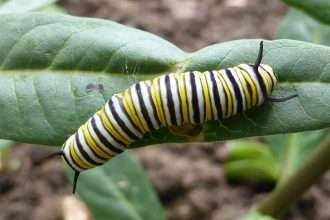
Photo: Monarch Caterpillar on Native Butterfly Weed
Photo credit: M Hedin/Flickr
1 Comment
More from EcoBlog
Fall Planting With Woodies – Native Trees & Shrubs
Some of our most ecologically-important native plants are trees and shrubs (aka woodies). They provide critical structure and ecological function to our landscapes. Some are early pollen sources for hungry bees, some have fruits, nuts or seeds for birds and mammals, some are host plants for butterflies, some are nesting…
The Value of Signs in an Ecological Landscape
How do you communicate to your neighbors why you have little or no lawn, why you have a diversity of native plants, why your trees are not topped, why your shrubs are not pruned into meatballs, why you leave your perennials and grasses standing through winter? Many of our neighbors…
A Closer Look at Monarchs & Milkweeds: Latest Information from Xerces
Milkweeds (Asclepias species) are getting a lot of attention these days since they are the only larval host plants for the threatened Monarch Butterfly. As you may know, butterfly caterpillars have a different diet than their adult counterparts. Most caterpillars eat plant parts, usually leaves. Monarch caterpillars only eat the…
I am program director for Teaneck Garden Club and also head up the Native Plants/Butterfly garden. Very intersted in your blog so please include me in your emails.
Also, any other info or websites for more info.
Thanks, looking forward and to learn more.