


EcoBlog
The latest thinking on ecological landscapes. Useful tips to improve our environment


Going Pesticide-Free for Pollinators at The Farm Between
This past August, I took a road trip to one of my favorite states, Vermont, where lots of good things are happening with organic and pesticide-free landscapes and nursery production. One of my stops was “The Farm Between” in pastoral Jeffersonville, Vermont. This is one of the oldest farms in the area, dating back to the early 1800s; it used to be a dairy farm – that is until the visionary co-owners, John and Nancy Hayden purchased it in 1992.
The Farm Between is an organic nursery that specializes in fruit trees, berry-producing shrubs, and a variety of pollinator plants. They grow over 30 different types of fruit – all without a single speck of pesticide – not even organic pesticides.
What you notice on this 14 acre farm is not just the prominently placed “Pesticide-Free Zone” sign, but the abundance of insect activity and the notable presence of many colorful strips of native wildflowers. Another interesting feature is their “Bumble Culture,” a pollinator-centric riff on Hugelkultur, a technique used in permaculture. (Stay tuned for an upcoming video on Bumble Culture at The Farm Between).
The Haydens are both ecologists by training and have a very different approach to fruit production than most fruit growers. They have planted their entire farm as a “pollinator sanctuary.” Their website proudly proclaims “we allowed native plants like milkweed, boneset, goldenrod, joe pye weed and others to proliferate. We planted hundreds of trees like willow and silver maple (great early pollinator trees), black locust (great June pollinator tree), and others as well as native shrubs and perennials to provide season-long nectar resources for pollinators.” Clearly this is not your average farm!
At The Farm Between, they plant for biodiversity, believing that a highly diverse array of plants and insects will keep the natural balance – eliminating the “need” for pesticides. “We don’t know enough about pesticides,” John Hayden told me, and “their long-term effects on bio-diversity.” He sees the beauty in chewed-on leaves, which confirms that his farm is supporting a bio-diverse ecosystem.
Hayden explained that once you introduce pesticides in a landscape, even organic pesticides, non-target insects like pollinators and beneficial insects can be harmed. And, who wants to eat fruit that is loaded with pesticides, even if it is organic! Hayden adapts his market to accept less than perfect fruit – a much healthier alternative.
This forward thinking at The Farm Between is not limited to farming and nursery production – you can have the same great ecological results in a residential landscape. Hayden advises homeowners to change their aesthetic, and go pesticide-free, to support healthier ecosystems.
Watch my first video interview with John Hayden here. I will be releasing more videos with John at The Farm Between, so stay tuned.
From Kim Eierman at EcoBeneficial!
More from EcoBlog

Water for Birds and Other Wildlife
Water is the number one thing that birds and other wildlife have the hardest time finding on their own and it’s often the one thing that we often forget to include in our landscapes. If you are lucky enough to have a pond, a lake or a stream on your…
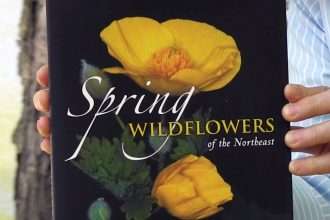
Book Giveaway & New Video: Carol Gracie on Spring Wildflowers part 2
EcoBeneficial! book giveaway! Win a Copy of Carol Gracie’s wonderful book on Spring Wildflowers! Watch part 1 or part 2 of the EcoBeneficial! interview with Carol Gracie. Click at the end when prompted. (If you are watching on an iPhone the banner does not display. Please submit you entry using…

Spring Wildflowers With Carol Gracie part 1
After a long, cold, seemingly never-ending winter, what a treat it was to go on a spring wildflower hike with author, photographer and naturalist Carol Gracie. Gracie is the author of two excellent books on wildflowers. Her first book, Wildflowers in the Field and Forest: A Field Guide to the…