


EcoBlog
The latest thinking on ecological landscapes. Useful tips to improve our environment


Native Bees: The Forgotten 4,000
We all know the European honey bee (Apis mellifera) because of its amazing ability to produce that golden liquid, honey. But, did you realize that there are more than 4,000 species of bees which are native to the United States?
Native bees vary tremendously in size, color, habitat, nest types, how they feed their larvae, etc. Native bees also have life styles which are different than honey bees; most native bee species are solitary, although some native species (bumblebees) are social. They all have important functions as pollinators in our environment and are regarded as “keystone organisms,” which ecosystems depend upon.
Some native bees are generalists and pollinate a wide variety of plants; some are specialists and are co-dependent on certain plant species, which become extinct without these pollinators which have co-evolved with them. Before European settlers introduced honey bees in the U.S., native bees were providing all those pollination services.
Certain native plants cannot be pollinated by honey bees at all, and certain plants are much more effectively pollinated by native bees. For example, native bumble bees are the most efficient pollinators of Blueberry plants (Vaccinium). Bumble bees vibrate their wings and thorax while nectaring on blueberry flowers and those vibrations shake the pollen off the flowers’ anthers onto the bees’ bodies. This is known as “buzz pollination,” something which honey bees cannot do.
Share the love! Plant for all of our important pollinators – native bees and honey bees alike!
Here are some terrific resources for more information:
Xerces Society: www.xerces.org/
Books: Attracting Native Pollinators
The Forgotten Pollinators
Managing Alternative Pollinators
Happy Planting from Kim Eierman at EcoBeneficial!
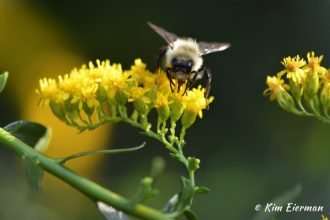
Photo: Bumble Bee Nectaring on Blueberry Flower (Vaccinium)
Photo credit: Flickr/Bob MacInnes
www.flickr.com/photos/lonetown/3520227398/in/photostream/
More from EcoBlog
The Pollinator Victory Garden: Winning the War on Pollinator Decline
You don’t have to be a gardener or a landscape professional to know that many pollinators are in trouble. The White House has taken notice and on May 19, 2015, released the “Pollinator Research Action Plan.” In the summary of the plan, three “overarching goals” are cited; unfortunately, our 4,000…
Welcoming Birds Back to the Garden this Spring
As the weather warms, neo-tropical migrating birds start to reappear in our landscapes. Are you ready to offer a proper welcome? Resources can be slim at this time of year in our landscapes, both for overwintering birds and returning migrants. Now more than ever, we need to provide welcoming habitats…
Native Bogs with Ron Determann of Atlanta Botanical Garden
If you haven’t seen a native bog in full bloom, then make sure to put that on your bucket list. A recent trip south this fall provided me with the excuse I needed to see the splendid bog gardens at the Atlanta Botanical Garden. Both ornamental and endangered, native bogs…