


EcoBlog
The latest thinking on ecological landscapes. Useful tips to improve our environment


What Your Native Plants Are Doing When You’re Not Looking: In the Garden with Doug Tallamy
It is estimated that more than 90% of the insects in our home landscapes are benign or beneficial. Why then do so many folks spray pesticides that kill not only insect “pests” but all the beneficial insects, too? Instead of reaching for the spray, let’s use native plants to support beneficial insects and the natural predators that keep pests under control.
During a recent visit with Dr. Doug Tallamy at his home, Doug showed me many examples in his own yard of native plants that support the “good bugs,” helping to keep nature in balance. Doug pointed out a Viburnum dentatum (Arrowwood Viburnum) which he had not planted – it had popped up in his yard on its own, the seed likely transported by a bird after it enjoyed eating one of the blue berries.
Arrowwood Viburnum is one of several host plants for the intriguing caterpillar of the Saddleback Caterpillar Moth. These caterpillars have adapted to eat the leaves of Viburnums and several other native plants. While this caterpillar is not considered to be a significant pest, it is kept in check by natural predators, such as the larvae of braconid wasps.
Just tucked under a leaf of Doug’s Viburnum was one such Saddleback caterpillar, looking very other-wordly with prickly spikes and spines protruding from its colorful body (yes, they do sting). Also protruding from the caterpillar were small, fluffy white tufts – the larvae of a Braconid Wasp, which make a meal of the Saddleback caterpillar and eventually kill it. An ecological food web in action! Check out my video with Doug Tallamy to see this fascinating interaction.
By planting appropriate, regional native plants you can help keep nature in balance in your own yard and support this kind of healthy local ecosystem.
Thinking about planting Viburnum dentatum? Here is some additional information:
– Botanical name: Viburnum dentatum.
– Common name: Arrowwood Viburnum.
– Native to: Eastern U.S. (Maine to Illinois, south to Texas and Florida).
– Zones: 4 to 9.
– Plant in full sun to light shade for best flowers and fruit.
– Prefers moist to average garden soil. Will tolerate somewhat dry soil.
– Size at Maturity: 6 to 12 feet high by 4 to 10 feet wide.
– Several cultivars are available at nurseries.
– Self-fruitful.
– Creamy white flowers in late Spring.
– Deep blue berries in late summer to early fall.
– Viburnum dentatum is a target for an exotic pest, the Viburnum Leaf Beetle.
Happy ecological planting from Kim Eierman at EcoBeneficial!
Photo: Caterpillar of the Saddleback Caterpillar Moth parasitized by Braconid Wasp larvae
Photo credit: Rick Schmidt
More from EcoBlog

To Mulch or Not to Mulch: Protecting Plants in Winter
As winter creeps up on us and the ground starts to freeze in many parts of the country, you may be wondering if you should use mulch to protect your plants. You may know that I recommend leaving fallen leaves in place to act as nature’s mulch and compost. Ditto…
Top 20 Ways to Create An EcoBeneficial Garden
Wondering how you can give a huge “eco-boost” to your garden? Look no further. Here are 20 of the best ways: 1) Reduce or eliminate the “Green Desert” (lawn/turf). It is an ecological wasteland. 2) Increase the health of your soil. Everything starts with the soil: healthy soil makes for…
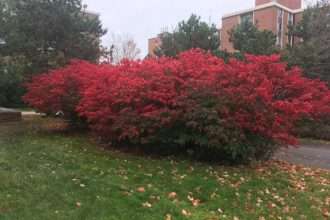
Spotlight on Invasive Plants: Burning Bush (Euonymus alatus)
At this time of year, there are some very compelling plants in the landscape, strikingly beautiful as they take on their amazing fall color. One of the loveliest to look at is Euonymus alatus, commonly known as burning bush or winged euonymus. Its foliage and unusual fruit begin to turn bright…