


EcoBlog
The latest thinking on ecological landscapes. Useful tips to improve our environment


Plant It and They Will Come: Cedar Waxwings & Serviceberries
The Cedar Waxwing is one of my favorite bird species – the adults with their sleek tan and gray Cardinal-like bodies, bright red spots on their wing tips and yellow “paint” on the tips of their tails, but best of all – their Zorro-like masks.
Chances are, you have Cedar Waxwings around at some point in the year, as they are found in most parts of the U.S. Their breeding range extends from the southern half of Canada to the northern half of the United States. In winter they range from many parts of the U.S., down through Mexico and south to Panama. Cedar Waxwings are most abundant in the Northeast and the Great Lakes region.
You can attract Cedar Waxwings to your landscape, with the right mix of native plants, providing them with cover, nesting sites and food sources. Don’t forget to include a clean source of water, too.
Cedar Waxwings are frugivores (fruit-eaters) and they subsist mainly on fruit, although they do eat insects. They prefer small fleshy fruit with a high sugar content and eat these fruits whole. In the absence of native fruits, Cedar Waxwings will eat the fruit of a number of highly invasive exotic plants, such as Autumn Olive, spreading these invasives as they eliminate the seeds. Why not plant native this spring to support Cedar Waxwings and your local ecosystem?
One type of native plant is irresistible to Cedar Waxwings: Amelanchier (aka Serviceberry, Juneberry). If you plant it, they really do come. It’s quite amazing! I never saw a Cedar Waxwing in my landscape until I planted two Serviceberries. How they found these plants, I haven’t a clue… but they did, and they come back every year for the fruit.
Cedar Waxwings like to feast in groups, and they are not alone in loving Serviceberries – at least 35 species of birds eat the fruit, including: Mocking Birds, Robins, Catbirds, Baltimore Orioles, Grosbeaks, Thrushes and others. So, think about planting more than one plant to keep everyone happy.
An added bonus – Serviceberry fruits are edible by humans and are highly nutritious. Admittedly, some species are tastier than others – Amelanchier x grandiflora (a native hybrid) is my favorite in the Northeast – the freshly picked berries eaten on cereal, or cooked in a pie. Amelanchier alnifolia (Saskaton Serviceberry) is a particularly delicious Western species.
Serviceberries not only provide tasty fruit to many birds, but support many pollinating insects and are the larval host plants for a number of butterflies and moths including: Striped Hairstreak, California Hairstreak, White Admiral, Western Admiral (aka Weidemerer’s Admiral), Two-tailed Tiger Swallowtail, Viceroy, Small-eyed Sphinx Moth and the Blinded Sphinx Moth.
If you decide to plant Serviceberries, there are approximately 20 species in the U.S. Do your research to determine the best choice(s) for your region and your local ecosystem (the Ladybird Johnson Wildflower Center database is a great place to start). Some species will be widely available at nurseries and garden centers, others will most easily be found at local native plant sales. Here is a sampling:
Amelanchier alnifolia (Western Serviceberry)
Amelancheir arborea (Downy Serviceberry)
Amelanchier bartramiana (Mountain Serviceberry)
Amelanchier canadensis (Shadbush)
Amelanchier x grandiflora (Apple Serviceberry)
Amelanchier humilis (Low Serviceberry)
Amelanchier laevis (Allegheny Serviceberry)
Amelanchier nantucketensis (Nantucket Serviceberry)
Amelanchier sanguinea (New England Serviceberry)
Amelanchier stolonifera (Running Serviceberry)
Amelanchier utahensis (Utah Serviceberry)
Feed a Cedar Waxwing – Plant a Native Serviceberry!
From Kim Eierman at EcoBeneficial! www.ecobeneficial.com
Photo: Cedar Waxwing With Its Favorite Fruit – Serviceberries
Photo credit: Flickr_Upupa4me
More from EcoBlog

To Mulch or Not to Mulch: Protecting Plants in Winter
As winter creeps up on us and the ground starts to freeze in many parts of the country, you may be wondering if you should use mulch to protect your plants. You may know that I recommend leaving fallen leaves in place to act as nature’s mulch and compost. Ditto…
Top 20 Ways to Create An EcoBeneficial Garden
Wondering how you can give a huge “eco-boost” to your garden? Look no further. Here are 20 of the best ways: 1) Reduce or eliminate the “Green Desert” (lawn/turf). It is an ecological wasteland. 2) Increase the health of your soil. Everything starts with the soil: healthy soil makes for…
Spotlight on Invasive Plants: Burning Bush (Euonymus alatus)
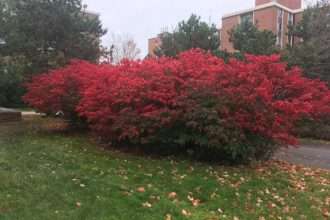
At this time of year, there are some very compelling plants in the landscape, strikingly beautiful as they take on their amazing fall color. One of the loveliest to look at is Euonymus alatus, commonly known as burning bush or winged euonymus. Its foliage and unusual fruit begin to turn bright…