


EcoBlog
The latest thinking on ecological landscapes. Useful tips to improve our environment


Easy Native Perennials to Start from Seed: Economical and EcoBeneficial!
Biodiversity is critical to the health of ecosystems but species diversity is crashing and getting worse in the face of climate change. How can you help? Skip the clones of native plants (grown from cuttings or tissue culture) and plant native seeds to increase genetic diversity to support our challenged environment.
In many cases, native plants require some type of pretreatment to germinate, such as chilling, wetting, or abrasion of the seed coat. But there are a number of native plants that are easy to grow from seed. (With very fine seeds, make sure not to plant them too deeply – they should be planted near the top of the soil level). Remember to use plants that are native to your region, and appropriate for your site.
If planted in a warm location, many native grasses need no pretreatment in order to germinate including:
- Andropogon gerardii (Big bluestem)
- Bouteloua species (Grama grasses)
- Elymus species (Rye grasses)
- Eragrostis spectabilis (Purple lovegrass)
- Muhlenbergia species (Muhly grasses)
- Panicum virgatum (Switchgrass)
- Schizachyrium scoparium (Little bluestem)
- Sorghastrum nutans (Indian Grass)
- Sporobolus heterolepis (Prairie dropseed)
Some native flowering perennials will also germinate easily without a pretreatment including: Allium candense (Wild garlic), Echinacea purpurea (Purple coneflower), Helenium autumnale (Sneezeweed), Pycnanthemum species (Mountain mints) and Veronicastrum virginicum (Culver’s root).
Here are some native flowering perennials that are easy to grow from seed:
- Agastache foeniculum (Anise hyssop)
- Allium candense (Wild garlic)*
- Asclepias species (Milkweeds)
- Campanula rotundifolia (Harebell)
- Echinacea purpurea (Purple coneflower)*
- Eupatorium hyssopifolium (Hyssop-leaved boneset)
- Eupatorium perfoliatum (Boneset)
- Eutrochium maculatum (Spotted Joe Pye weed)
- Eutrochium purpureum (Sweet Joe Pye weed)
- Gaillardia aristata (Blanket flower)
- Helenium autumnale (Sneezeweed)*
- Helenium flexuosum (Purple-headed sneezeweed)
- Helianthus angustifolius (Swamp sunflower)
- Helianthus divaricatus (Woodland sunflower)
- Heuchera americana (Common alumroot)
- Heliopsis helianthoides (Oxeye sunflower)
- Lobelia cardinalis (Cardinal flower)
- Mentha arvensis (Wild mint)
- Monarda didyma (Scarlet beebalm)
- Monarda fistulosa (Wild bergamot)
- Monarda punctata (Spotted beebalm)
- Oenothera fruticosa (Sundrops)*
- Oenothera lindheimeri (White gaura)*
- Oligoneuron album (Upland white goldenrod)
- Penstemon digitalis (Beardtongue)
- Physostegia virginiana (Obedient plant)
- Pycnanthemum muticum (Blunt-leaved mountain mint)*
- Pycnanthemum tenuifolium (Thin-leaved mountain mint)*
- Pycnanthemum virginianum (Common mountain mint)*
- Ratibida columnifera (Long-headed coneflower)
- Ratibida pinnata (Gray-headed coneflower)
- Rudbekia hirta (Black-eyed Susan)
- Rudbeckia laciniata (Cut-leaf coneflower)
- Rudbeckia maxima (Giant coneflower)*
- Rudbeckia triloba (Three-lobed coneflower)
- Salvia azurea (Blue sage)*
- Salvia lyrata (Lyre-leaf sage)*
- Symphyotrichum ericodes (Heath aster)*
- Symphyotricum laeve (Smooth blue aster)
- Symphyotrichum laterifolium (Calico aster)
- Symphyotricum oblongifolium (Aromatic aster)
- Veronicastrum virginicum (Culver’s root)*
*No pretreatment needed
For more information on the seed germination requirements of native perennials, I recommend Prairie Moon Nursery’s Cultural Guide and William Cullina’s book Wildflowers: A Guide to Growing and Propagating Native Flowers of North America. Not all sources are in 100% agreement on every species.
And, here are some online sources that sell native plant seeds:
Prairie Moon Nursery (excellent cultural guide on seed germination)
Wild Seed Project
Ernst Conservation Seeds (species by the pound)
Prairie Nursery
Shooting Star Native Seeds (bulk orders)
Toadshade Wildflower Farm
Roundstone Native Seed Company
Happy Germinating from Kim Eierman at EcoBeneficial!
Photo: Campanula rotundifolia (Harebell)
Photo credit: Flickr/Matt Levin
1 Comment
More from EcoBlog

To Mulch or Not to Mulch: Protecting Plants in Winter
As winter creeps up on us and the ground starts to freeze in many parts of the country, you may be wondering if you should use mulch to protect your plants. You may know that I recommend leaving fallen leaves in place to act as nature’s mulch and compost. Ditto…
Top 20 Ways to Create An EcoBeneficial Garden
Wondering how you can give a huge “eco-boost” to your garden? Look no further. Here are 20 of the best ways: 1) Reduce or eliminate the “Green Desert” (lawn/turf). It is an ecological wasteland. 2) Increase the health of your soil. Everything starts with the soil: healthy soil makes for…
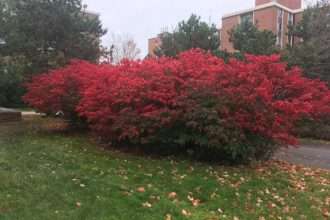
Spotlight on Invasive Plants: Burning Bush (Euonymus alatus)
At this time of year, there are some very compelling plants in the landscape, strikingly beautiful as they take on their amazing fall color. One of the loveliest to look at is Euonymus alatus, commonly known as burning bush or winged euonymus. Its foliage and unusual fruit begin to turn bright…
Thanks for emphasizing importance of true native seeds, as well as planting for eco-region; too many people still aren’t aware of the importance of biodiversity and that there are so many differences in ecological areas. For instance, we have 10 distinct ecoregions in Texas.
Please include Native American Seed, in Junction TX in your seed provider list.
They sell native seeds of grasses and wildflowers and offer historical and current information that is very helpful via their website http://www.seedsource.com