


EcoBlog
The latest thinking on ecological landscapes. Useful tips to improve our environment


The Native Flora-Fauna Connection: The Complexity of Native Plants
I recently had the pleasure of hearing Dr. Doug Tallamy speak again. For those of you who have not yet read his book, “Bringing Nature Home,” I encourage you to rev up your Amazon account or drive to a bookstore (remember those?) and buy his book today. Tallamy is an entomologist, specializing in lepidoptera (butterflies, skippers + moths), and has made the compelling case for a number of years that native critters (fauna) are dependent on native plant (flora).
If you have been reading this blog, you know by now that I am in complete agreement with Tallamy, and I believe that all living things are connected to all other living things in an ecosystem. My approach is: let’s garden for an entire food web, supporting local ecosystems and regionally native species.
In my lectures and classes, I often get asked thoughtful questions including: “what is so bad about invasive plants – don’t they fill an ecological niche?” or “I see insects going to exotic plants – what’s the problem?”
Through some of his research, Tallamy has shown that exotic plants do not fill the same ecological niche as native plants for lepidoptera (butterflies et al) and their predators, usually birds. In fact, relatively few fauna species seem have adapted to exotic plants, including the “bad boy” exotics – invasive plants.
We now know that the fruit of some exotic plants, such as the berries of Japanese Honeysuckle, while relished by migrating birds, offer empty calories, compared to the nutrition-packed berries of native plants which those birds have evolved with and depend upon.
There are many perplexing ecological questions which science has not yet fully answered. Here are a just a few:
1) “Do cultivars of native plants provide the same resources in an ecosystem as “straight species” native plants?”
Does a Monarch caterpillar get the same nutrition from Asclepias incarnata ‘Ice Ballet’ as it does from the straight species Asclepias incarnata (Swamp Milkweed)? We already know that double-flowered hybrids typically have little or no nectar, pollen or seeds. How about the value of their foliage? What else don’t we know?
2) “Given climate change, should I start planting more southern species and what will the impact be on my ecosystem?”
Some folks are embracing “assisted migration” where we try to save some southern species by planting them further North. Will our native fauna derive the same value from a regionally native plant as from a “southern cousin?” We just don’t know.
3) “When I use deer repellent on a plant, does it impact native insects which utilize that plant?”
We know that bees have a strong sense of smell, butterflies taste with their feet, and other insects can sense the chemical composition of leaves. It stands to reason then that a garlic or egg-based brew in many deer repellent sprays is detected by insects, and they may likely avoid those plants which have been sprayed. I asked Tallamy about this and he told me that the research just isn’t there yet.
Some folks advocate that we accept “novel ecosystems,” those ecosystems which have been invaded and altered by “bad boy” exotics, and let the ecological dice fall where they may. In general, I don’t agree with this passive approach. While some ecosystems may be beyond repair, I believe that each of us can make a huge difference by gardening ecobeneficially in our yards, our community gardens, our corporate parks, our rooftops, our farms, etc. If we don’t try to save our local species and our local ecosystems who will?
Please share your thoughts on these important topics.
Happy EcoBeneficial Gardening from Kim Eierman
Photo: Spicebush Swallowtail Caterpillar Contemplating a Meal
Photo credit: Flickr_Michael Hodge
www.flickr.com/photos/27142448@N00/1216909436/in/photolist-2RwYMb-6W51cv-6SQqgS-4HrkUU-oQMt
More from EcoBlog
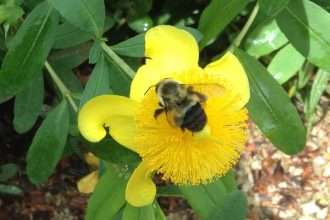
Feeding the Bees: Creating a Bee Buffet!
We are hearing more and more about the challenges which honey bees and native bees are facing. There are many things you can do in a landscape to help bees. One thing we all can do is create an appealing and nutritious “bee buffet” to help our pollinator friends. As…

Host Plants: Feeding Caterpillars = Building Butterflies
Many homeowners and landscapers don’t realize the futility of just planting exotic nectar plants to support butterflies. Caterpillars of butterflies have evolved with specific host plants on which they depend. Some caterpillars use a very limited number of native host plants, some have the ability to use a wider range…
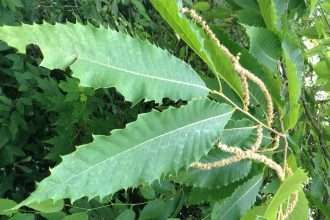
Preserving Native Species: Lessons from the American Chestnut
Prior to the year 1900 the American Chestnut tree (Castanea dentata) was the predominant tree in Eastern forests. It is estimated that there were almost 4 billion American Chestnut trees in the U.S. at the beginning of the 20th century, accounting for 1 in every 4 trees in Eastern hardwood…